Technical note · terminology
Sauna or steam room? The one-line difference that decides your BOQ
In an Indian tender the word sauna can mean either room. They differ in temperature, in heater, in materials and in ventilation, and a BOQ that does not say which prices the wrong one. This note gives the differences, and the lines that fix them.
In this note
Two rooms, one word
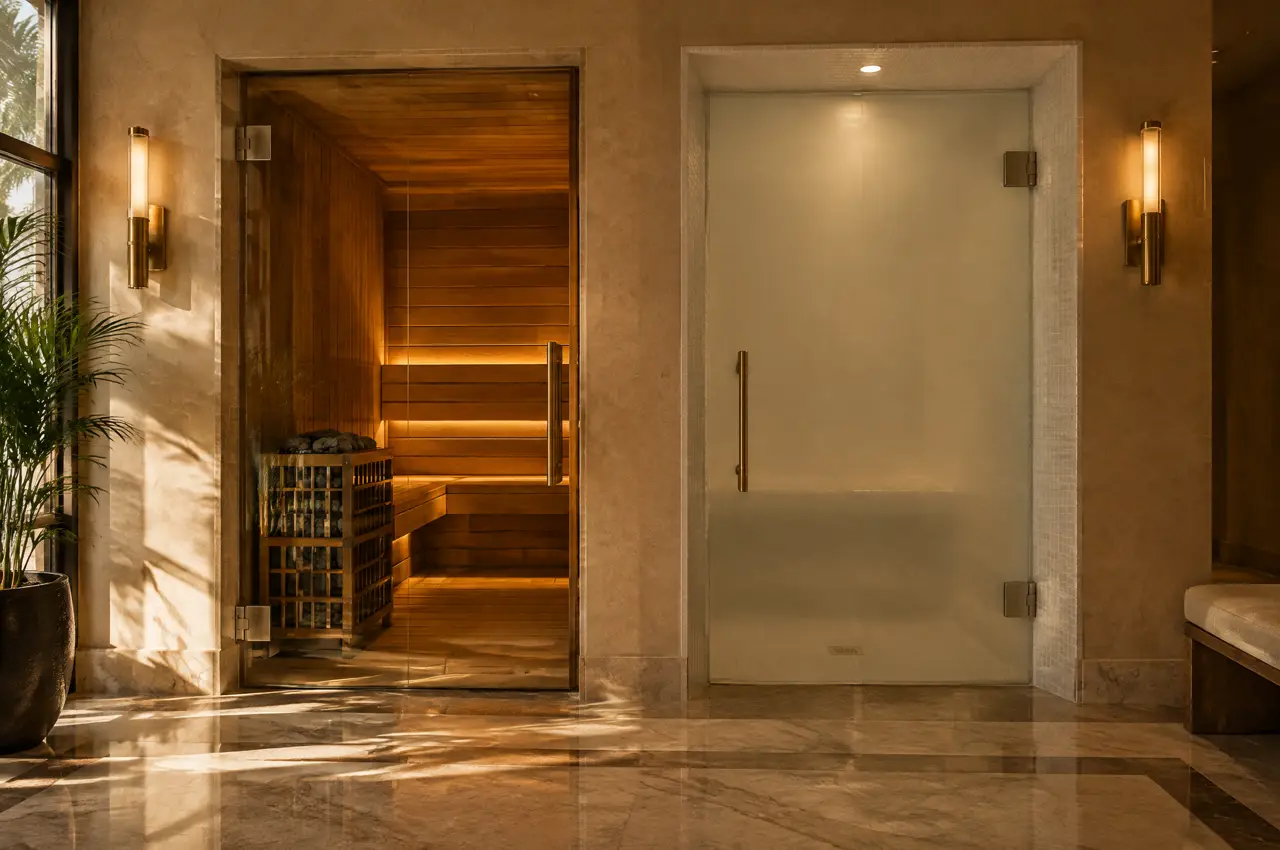
A Finnish-style dry sauna is a timber cabin heated by a stove of stones to 90-110 °C, with low humidity and a ladle of water thrown on the stones for a short burst of steam when the bather wants it. A steam room is a tiled or solid-surface room filled with steam from a generator, run far cooler: Harvia, the Finnish heater maker, gives 45 to 50 °C as the ideal temperature for one. In India the word sauna is used for both, so a line that reads sauna for 6 persons, complete can be answered with two completely different rooms. We build the first. We do not build steam rooms, hammams or salt rooms.
What differs, line by line
| Property | Dry sauna (Finnish style) | Steam room |
|---|---|---|
| Working temperature | 90-110 °C | 45-50 °C (Harvia's guidance) |
| Air | Low humidity; water on the stones for short bursts | Steam in the air for the whole session |
| Heat source | Electric heater with stones | Steam generator |
| Shell | Insulated timber cabin with a vapour barrier and an air path | Waterproofed room, tile or solid surface, sloped ceiling, drain |
| Surfaces and seats | Thermally modified timber or cedar benches | Tile, stone or solid-surface seats |
| Ventilation | Fresh-air inlet near the heater, exhaust on the far side | A closed room with controlled extract and a drain |
| Upkeep | Stones checked, benches wiped, door ajar to dry | Generator descaling, grout and mould control |
How the mix-up shows up in a tender
Two bidders read the same line. One, a steam-equipment supplier, prices a generator, tiling, a drain and a sloped ceiling. The other, a timber supplier, prices a cabin and a heater. Their numbers differ by a wide margin and neither is wrong. The comparison sheet then rewards the cheaper reading, the consultant discovers the mismatch at design review, and the programme loses the weeks that the correction takes. The fix costs one sentence at the start.
Words that fix the line
For a dry sauna, write:
- Dry sauna cabin, Finnish type, seats and cabin dimensions stated, working temperature 90-110 °C, low humidity.
- Electric heater with stones, rated power in kW and the supply it needs, mounted behind a timber guard.
- Thermally modified timber or cedar cladding and benches, insulated shell, vapour barrier, air inlet and exhaust.
- Glass front or glass walls as drawn; door opening outwards; indirect lighting; control panel outside the cabin.
For a steam room, a different set applies, and it is a different trade:
- Steam room, working temperature about 45-50 °C, steam generator with its rating and water supply.
- Waterproofed shell, tile or solid-surface finish, sloped ceiling, floor drain and extract.
Infrared cabins are a third thing
An infrared cabin heats the bather directly with radiant panels, not the air with a stove. It appears next to sauna heaters in the same item of the BIS order described in the paperwork note, which is a reason to name it separately in a BOQ. It is not in our range for India.
The heater, the supply and the mains
Small cabin heaters run on a single-phase supply; larger ones, from about 8 kW, need three phases, and a manufacturer such as Harvia lists a 400 V 3N~ electrical group for its larger heaters. On the mains, BIS standard IS 12360 gives 50 Hz as the frequency and lists 230 V single-phase and 230/400 V three-phase as preferred values; BIS has kept the changeover from 240/415 V in abeyance since 2011, so an existing supply may still be 240/415 V. Confirm the supply with your utility and put the figure in the BOQ.
Which one do you need?
| If the brief says | It means | Write |
|---|---|---|
| Finnish, löyly, sweat, stones, 90 degrees | Dry sauna | Dry sauna cabin, 90-110 °C, heater and stones |
| Steam, hammam, 100% humidity, steam generator | Steam room | Steam room, 45-50 °C, generator, tiled shell |
| Infrared, panels, far-infrared | Infrared cabin | Infrared cabin, panels, power, a separate item |
What a consultant checks at design review
- That the BOQ line names the room: dry sauna or steam room, with the working temperature.
- That the heater's rating and supply appear on the electrical schedule, and a feeder and DB way are reserved.
- That the cabin's exhaust has a route out of an air-conditioned room, and that the route is drawn.
- That a floor drain exists only where the room needs one: a steam room does; a dry sauna does not.
- That finishes suit the room: timber inside a dry sauna, tile or solid surface in a steam room.
- That the door, the glass and the lighting match the room's heat and are rated for it.
Five assumptions to test, and what is wrong with them
- A sauna needs a drain. A dry sauna does not; a steam room does.
- Tile is fine in a sauna. At 90-110 °C, tile and grout are the wrong material; the bench would be too hot to sit on.
- One room can be both. A cabin that tries to be both is a poor example of each.
- More steam is more sauna. A dry sauna is judged by its heat and its air, not by its fog.
- The heater and the generator are interchangeable. They are different machines with different supplies, water connections and maintenance.
Can a dry sauna make steam?
In bursts. A ladle of water on the hot stones releases steam for a moment and the humidity falls again. The cabin stays a dry sauna.
Can a steam room be converted into a sauna?
Rarely. The shell, the materials and the ventilation are different. We would build a cabin inside the room rather than convert the room.
Do you build steam rooms?
No. We build dry saunas, cold plunge pools, hot and cold suites, tubs and the chillers behind them.
Further notes
Technical notes that continue this one
Heater paperwork for tenders
The BIS order of 2026, the EU declaration, mains data and origin papers: what to ask for with an imported heater.
Open the page
Spec-sheet checklist for consultants
Thirty-six lines on geometry, loads, electrical, water, air and safety, for a sauna and cold plunge package.
Open the page
GST and customs on a quote
Price, customs duty, surcharge, IGST and GST: the layers of an imported quote and who decides each.
Open the pageFrom note to drawing
Send the BOQ line; we return it in words that price the right room
Send the plan; the layout comes back
A floor plan or three photographs, the location of the distribution board and what you intend to build. The reply is a 3D layout, an equipment schedule and a range in lakh.
Open WhatsApp with the briefSpecify the suite first