Cities · the whole country
One equipment range, six reference climates and a method for any other Indian city
The six city pages record where the climate changes the specification. This page is for everywhere else: Jaipur or Kochi, Chandigarh or Coimbatore, a hill resort or a heritage hotel. It sets out the questions we ask, in the order we ask them, and how the answers become a layout.
In this note
- How a project outside the six is handled
- Six reference climates
- Heritage hotels and retreats
- Hill stations and the cold-climate question
- Freight, port and local trades
- Ten questions we ask every plot
- Which reference climate a place is read against
- What does not change between cities
- Why a project outside the metros starts with logistics
How a project outside the six is handled
- You send the location, a plan or photographs and what you want to build.
- We place the site against the nearest reference climate in the table below and say which one.
- We ask the ten questions at the end of this page and mark the ones other disciplines must answer.
- We return a 3D layout, an equipment schedule and an indicative range within 5 working days.
- Freight, local trades and approvals are listed as lines on the quote, with the questions beside them.
Six reference climates
These are India Meteorological Department station tables: 1991-2020 for Delhi, Mumbai (Santacruz) and Hyderabad, 1981-2010 for Bengaluru and Goa and 1981-2009 for Pune, with the Bengaluru, Pune and Goa figures rounded. We use them as reference points. A site in Jaipur sits near Delhi's column; one in Kochi near Goa's; one in Coimbatore or Mysuru near Bengaluru's.
| Station | Peak monthly mean max (°C) | Coolest monthly mean min (°C) | Annual rain (mm) | Elevation (m) |
|---|---|---|---|---|
| Delhi (Safdarjung) | 39.9 (May) | 7.5 (Jan) | about 760 | - |
| Mumbai (Santacruz) | 34.1 (Nov) | 16.9 (Jan) | 2,502 | - |
| Bengaluru | about 34 (Apr) | about 16 (Jan) | 1,000-1,100 | about 920 |
| Hyderabad | 39.7 (May) | 15.3 (Dec) | about 860 | 530-540 |
| Pune | about 38 (Apr) | about 11 (Jan) | 800-850 | about 560 |
| Goa | about 34 (May) | about 20 (Jan) | 2,800-3,000 | - |
The hottest-month figure sets the plant, the coolest-month figure sets the warm loop, and the rainfall sets the drains and the choice of timber and steel. No single figure replaces a site's own reading.
Heritage hotels and retreats
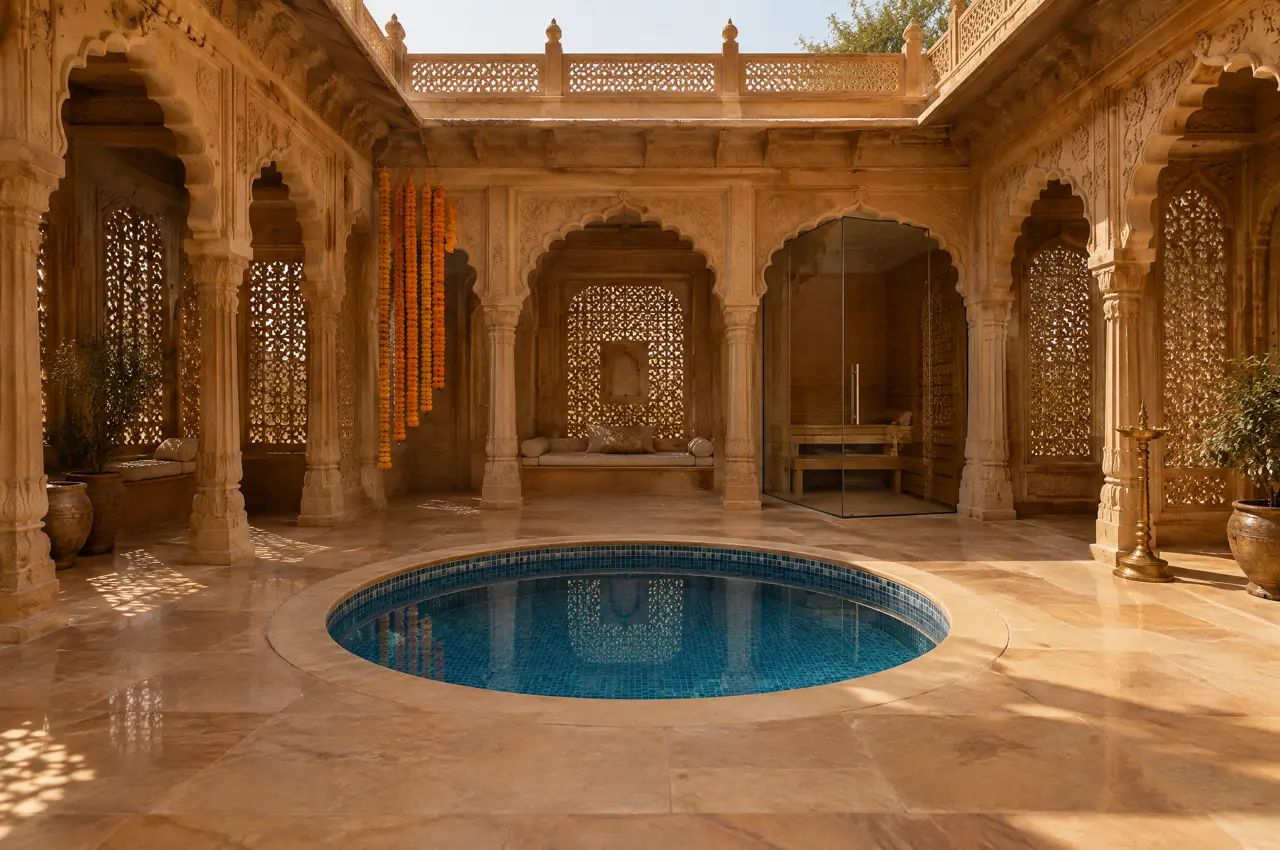
A restored haveli or a palace-hotel courtyard is a natural home for a plunge pool and a glass cabin set in an arched bay: the stone is thick, the courtyard is shaded and the water is a quiet counterpoint to the carved screens. The constraints are conservation and weight. A heritage building may restrict what can be fixed to a wall or set into a floor, and old floors rarely carry a pool's weight. We draw the pool on its own base, free of the historic fabric, and mark the conservation architect's approval as a line on the drawing. A retreat on the Kerala or Konkan coast follows the Goa rules for monsoon and salt.
Hill stations and the cold-climate question
In a cold hill climate the cabin is the main attraction and the cold pool changes character: the plant spends its time keeping water from freezing and the pool is used as a plunge after the cabin in crisp air. We design such a project with frost protection on the pipes, a cover for the pool and a plant room that stays above freezing; the layout states the design low temperature it assumes.
Freight, port and local trades
The quote names the port of entry, the freight route, the inland delivery and the lines for customs clearance and tax. Cabins travel as numbered panels and glass in its own crates. Our team supervises the installation; civil, plumbing and electrical trades are done by your contractor, working to our drawings. Outside the metros that coordination can decide the schedule, so it is the first line we ask about.
Ten questions we ask every plot
- What is the location, and which reference climate is nearest?
- What is the plan: dimensions, ceiling heights, levels and structure?
- Where is the DB, what supply does it have, and is there a generator?
- What supplies the make-up water, and what is its hardness?
- Where does the pool or the cabin drain to?
- What are the narrowest gate, lift, lane or turn between the road and the site?
- Is a crane needed, and where can it stand?
- Which approvals or no-objection letters does the site need, and from whom?
- What is the opening or occupation date?
- Who is the consultant or contractor we coordinate with?
Which reference climate a place is read against
| Place | Nearest reference climate | What we check first |
|---|---|---|
| Jaipur, Udaipur, Chandigarh | Delhi NCR | Winter lows for a warm loop; May heat for the plant; conservation limits in old buildings |
| Kochi, Kozhikode, Mangaluru | Goa | Monsoon rain, salt air, laterite and drain routes |
| Coimbatore, Mysuru | Bengaluru | Mild climate; finish and documentation |
| Ahmedabad, Nagpur | Hyderabad | Hot spring; shade and a water test |
| Himalayan and hill resorts | A separate cold-climate design | Frost protection, access roads and the delivery season |
The mapping is our working assumption for a first layout, and we replace it with the site's own temperature record when you can give us one.
What does not change between cities
The system does not change with the postcode: the same pools, the same cabins, the same plant, the same 40 / 40 / 20 payment and the same signed temperature test. What changes is the load the climate puts on it, the access to the plot and the number of other people who have to say yes. A project in Jaipur and one in Goa will share a plant and a payment plan and almost nothing else in their drawings.
Why a project outside the metros starts with logistics
In a metro the first questions are the slab and the society. Outside it, they are the road and the nearest trade. Can a truck reach the plot, can a crane stand beside it, is there a loading bay or only a gate, and is the nearest trade within a day's drive? Those answers set the schedule more than the climate does, which is why the first line of our questionnaire is the route, not the heat.
Do you work outside the six cities?
Yes, on request. Send the location and the plan; we place the site against the nearest reference climate and answer the ten questions on the quote.
Is freight more expensive outside the metros?
It can be. The quote shows freight and the inland leg as separate lines for your site.
Who installs outside the metros?
Our project team supervises. Local trades are your contractor's, working to our drawings.
How do you choose the reference climate for my site?
We take the nearest of the six stations that behaves like your place, say which one in the layout, and replace it with your site's own readings when you have them. A hill resort in a cold climate gets a separate design brief.
Your site, drawn
Send the location and the plan; the layout and the questions come back together
Send the plan; the layout comes back
A floor plan or three photographs, the location of the distribution board and what you intend to build. The reply is a 3D layout, an equipment schedule and a range in lakh.
Open WhatsApp with the briefSpecify the suite first