Technical note · materials
Monsoon humidity: which timber and which stainless steel survive Mumbai and Goa
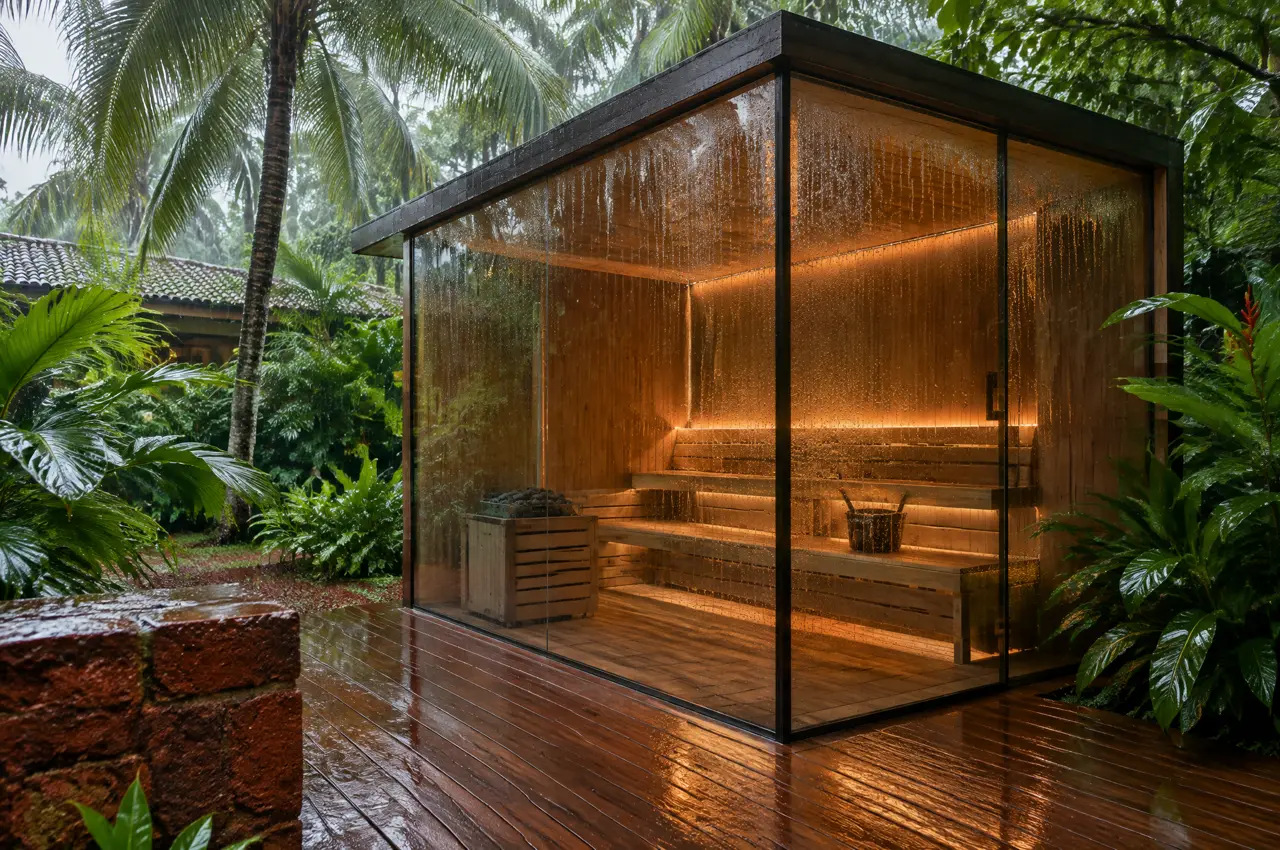
A sauna is a dry room that spends most of its life in a wet climate. For months it sits cold and idle in air close to saturation, then it is heated to 100 °C in an afternoon. What survives that cycle is a matter of timber, metal and routine, in that order.
In this note
- Four months of rain and a year of salt
- What humidity does to a cabin that is switched off
- Timber at a glance
- Why the cabin has an air path
- 304, 316 and why the coast needs the second
- Glass, gaskets and the control box
- A monsoon calendar for the caretaker
- What the annual service visit looks at
- Pool decks in the monsoon
Four months of rain and a year of salt
The south-west monsoon brings a humid, wet season to the west coast: June to September carry about 96% of the year's rain at Santacruz in Mumbai and about 91% in Goa, in the India Meteorological Department's tables. The salt in the air does not wait for the rain: on the coast it is there all year, deposited on glass, fasteners and the louvres of a plant niche. A cabin in Mumbai or Goa therefore faces two separate attacks. Moisture works on the timber. Chloride works on the metal. The remedies are different, and mixing them up is how a sound-looking cabin can end up with rust running from its hinges.
What humidity does to a cabin that is switched off
Timber takes up and gives off moisture until it matches the air around it. In the wet season an idle cabin settles at a much higher moisture content than the same cabin in an air-conditioned room; once the heater runs, the boards dry quickly and shrink. Repeated through a season, that cycle opens joints, cups wide boards and releases the bench screws. Two things reduce it: timber that takes up less moisture in the first place, and a habit of letting the cabin dry out between uses.
Timber at a glance
| Thermally modified timber | Red cedar | |
|---|---|---|
| Moisture behaviour | Heat treatment lowers moisture uptake, so boards move less between wet and dry seasons | Light and stable for a softwood, but moves more than treated timber |
| Colour | Deep honey to brown, deepening with heat | Pale to warm red, darkening slowly |
| Feel on skin | Warm; bench edges are rounded | Cooler and softer to the touch |
| Where we use it | Cabin cladding, benches and exterior in coastal and monsoon settings | Interiors where a lighter look is wanted |
| Care | Light oil on exterior timber once a year | Keep clear of direct rain and splash |
Neither species is varnished inside the cabin, since a coating softens and sticks at 100 °C. Cut edges are sealed, so that moisture does not run along the grain from an exposed end.
Why the cabin has an air path
Every cabin has fresh air entering low near the heater and leaving high on the far side, and a gap behind the cladding so the boards can dry on both faces. In the wet season the path matters more. After the last session leave the door ajar, let the cabin cool with the vents open, and run the heater for half an hour once a week if the cabin has not been used, to drive out stored moisture. A small dehumidifier in the room helps if the room is not air-conditioned.
304, 316 and why the coast needs the second
| Grade | What it contains | Where it is acceptable | Where it is not |
|---|---|---|---|
| 304 stainless | Chromium and nickel | Inland, dry rooms, interiors | Within reach of sea air, and any pool deck on the coast |
| 316 stainless | Adds molybdenum, which resists chlorides | Coastal settings, pool decks, rails, hinges, handles and fixings | Nowhere that cost matters more than corrosion |
Ordinary steel screws in cedar stain and fail, since cedar is acidic and attacks plain steel; the stain is the first sign of corrosion. We specify 316 for hinges, handles, bench brackets, the heater guard and every visible fixing, and plain steel nowhere.
Glass, gaskets and the control box
- Gaskets. Silicone, checked at each service visit; humid air finds a perished seal first.
- Glass. Wipe the inside after use to remove mineral marks from the ladle; squeegee the outside weekly.
- Control box. Mounted outside the cabin with an enclosure rated for a damp room; your electrician owns the rating and the point.
- Lights. Fittings inside the cabin are rated for its temperature, and cable entries are sealed.
A monsoon calendar for the caretaker
- Late May: oil exterior timber, check the roof drip edge, clear gutters, wash the plant's coil.
- June to September: run the cabin weekly, door ajar between uses, check pool drains after heavy rain.
- End of September: wash the coil again, inspect gaskets and fixings for rust, book the annual service visit.
- October: run the cabin for an hour with the door shut to start the dry season clean.
What the annual service visit looks at
- Timber: moisture marks, cupped boards, loose bench screws, and sealed cut edges where they meet glass or floor.
- Metal: hinges, handles, brackets and the heater guard, for the first brown mark that says plain steel is hiding somewhere.
- Gaskets and seals: cracking, flattening or mould along the glass and the door.
- The air path: inlet and exhaust clear of dust and insects; the gap behind the cladding dry.
- The plant: coil washed, drains clear, fixings and brackets sound, the control box dry inside.
- Pool decks and drains: falls still falling, overflow clear, soak pit not backing up.
Pool decks in the monsoon
A cabin shares its deck with a pool in many villa plans, and the deck takes the worst of the rain. Gaps between boards should drain, not hold water; a fall of a few millimetres per metre away from the cabin and the pool keeps the plinth dry; and an overflow that runs to a soak pit or a drain keeps the water in a heavy shower from climbing the coping. Wet teak and wet stone are both slippery, so a slip-rated finish and a brush at the door are worth more than any sign.
Will thermally modified timber survive the monsoon outdoors?
On a raised plinth with a roof drip edge and sealed cut edges, yes. It is the species we choose for coastal exteriors, and it still wants a light oil once a year.
Is 316 stainless really necessary inland?
Not in a dry inland room. On the coast, on a pool deck and anywhere near the sea it is the grade to specify; the cost of the dearer grade is small beside a replaced door.
Should the cabin be heated during the monsoon even if nobody uses it?
A weekly half-hour run, with the door ajar afterwards, is enough in most cases and drives out moisture before it settles into the boards.
Further notes
Technical notes that continue this one

A farmhouse sauna in Delhi NCR
Winter cabin, summer cold plunge: one NCR plot through a year, with the climate figures and the generator.
Open the page
Specifying a tub with a chiller
Litres, pull-down energy, design ambient, placement and power: the six numbers behind a chiller order.
Open the page
Spec-sheet checklist for consultants
Thirty-six lines on geometry, loads, electrical, water, air and safety, for a sauna and cold plunge package.
Open the pageFrom note to drawing
Send the site and the room; we specify timber and steel for your coast
Send the plan; the layout comes back
A floor plan or three photographs, the location of the distribution board and what you intend to build. The reply is a 3D layout, an equipment schedule and a range in lakh.
Open WhatsApp with the briefSpecify the suite first