System 11 · private homes only
A heated wooden tub for the cool evenings: timber outside, a white liner inside, 37-39 °C
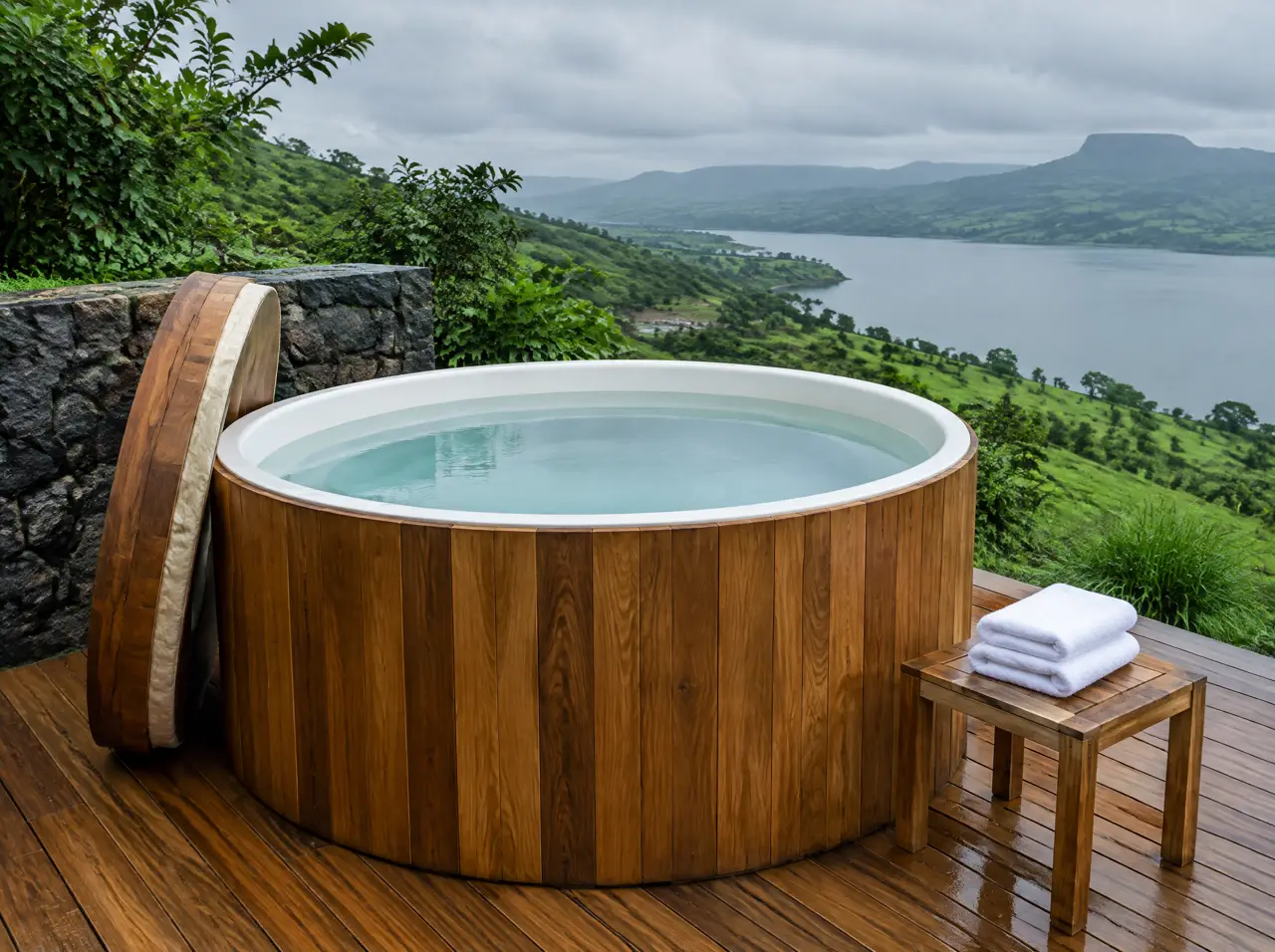
Two to six people in warm water under a Delhi winter sky or a Mulshi monsoon cloud, in a timber tub that carries no metal hoops and holds its water in a smooth white liner. An electric heater, a filter and an insulated cover make it a tub that is used on weeknights, not one that is filled for a festival and drained.
In this note
- Cold tub, hot tub: the same timber, a different machine
- Why ash or cedar, and why the liner is white
- Heating time, kilowatts and the cover
- Wooden tub or acrylic shell
- Where it earns its place: Delhi winters, Bengaluru evenings, the hills
- Monsoon, sun and the timber
- Water and power at a farmhouse
- Where it goes, and how it arrives
Cold tub, hot tub: the same timber, a different machine
The wooden plunge tub on the neighbouring page is this tub's cold twin: the same thermally modified staves, the same white liner, the same rule that nothing metal wraps the timber. The difference is the plant: the cold tub is cooled by a chiller sized by litres, this one is warmed by an electric heater sized by litres and by how fast the family wants it ready. It is a home product, and only that; a club or a hotel that wants warm water for a queue takes the hydromassage hot tub with its filtration turnover and its water log.
Why ash or cedar, and why the liner is white
Thermal modification cooks the sugars out of the timber, so ash and cedar staves take up far less water and move far less than raw wood through a monsoon and a dry April. Because the liner, not the timber, holds the water, the staves are cladding: they carry no load, need no hoops and can be re-oiled without draining the tub. The liner is white so that the water is seen to be clean, and smooth so that it can be wiped rather than scrubbed. A tub whose staves are the water barrier swells, weeps and blackens at the joints within a year in Goa.
Heating time, kilowatts and the cover
| Litres | kWh, 25 to 38 °C | Hours at 6 kW | Hours at 9 kW | kWh from a 15 °C winter fill |
|---|---|---|---|---|
| 1,000 | 15 | 2.5 h | 1.7 h | 27 |
| 1,400 | 21 | 3.5 h | 2.4 h | 37 |
| 1,800 | 27 | 4.5 h | 3 h | 48 |
The arithmetic is litres x kelvin x 4.186 kJ, divided by 3,600; a 15 °C fill is an assumption for a Delhi January, so measure yours. The practical answer is a timer and the insulated cover: the heater starts in the afternoon, the cover stays on until the family steps in, and on a second evening the heater lifts a few degrees instead of twenty. A 6 kW heater runs on a single-phase supply; 9 kW needs three phases, which a farmhouse DB usually has and an apartment usually does not.
Wooden tub or acrylic shell
| Heated wooden tub | Acrylic drop-in hot tub | |
|---|---|---|
| Look | Timber on a deck or a plinth; belongs in a garden | A moulded shell with a rim; belongs in a built-up deck |
| Jets | No jets by default; a quiet tub | Hydromassage jets and a jet pump |
| Plant | Heater, pump, filter beside the tub | Jet pump, heater or heat pump, filter in a plant room |
| Weight filled | 1 to 1.8 tonnes plus bathers | 2 tonnes and more for six |
| Care | Re-oil the staves yearly; wipe the liner; cover on | Dosing and filtration turnover as for a pool |
| Price position | ₹4.2-11.7 lakh | ₹8-25.5 lakh |
Where it earns its place: Delhi winters, Bengaluru evenings, the hills
Delhi's mean January minimum is about 7.5 °C (IMD, Safdarjung, 1991-2020); from November to February a farmhouse in Chattarpur uses a warm tub more than a cold one. Pune's January minimum is about 11.2 °C (IMD, 1981-2009), and the Sahyadri hills around Mulshi are cooler and wetter still, which is where the tub in the photograph stands. Bengaluru, at about 920 m, has evenings cool enough all year. In Goa and Mumbai the tub is a cool-season and monsoon-evening object, and the cold twin earns the summer.
Monsoon, sun and the timber
- Partial shade. Direct sun heats the deck and the staves; the cover protects the water, not the wood.
- Re-oil before the rains: one coat a year on thermally modified timber; the liner needs none.
- A deck or a stone plinth with a fall to a drain. A tub standing on soil makes a mud ring and a mosquito pond.
- Coastal plots: 316 fittings and a cover that fastens, because the monsoon wind lifts anything that does not.
Water and power at a farmhouse
Borewell water that scales a kettle scales a heater element faster, because the element runs for hours. A TDS and hardness test before the fill decides between a softener, an inhibitor and a mains fill; the filter and the UV stage run on the pump's timer whether anyone bathes or not. On an inverter, the pump and the controls run and the heater waits; the cover holds the evening's heat through a cut of an hour or two. On a generator set, the heater runs only if the set was sized for it. Residual-current protection and sockets outside the splash zone are your electrician's, to our layout.
Where it goes, and how it arrives
- Weight. 1,800 litres is 1.8 tonnes before the tub and six bathers; a terrace needs the slab check, a garden a level, firm base.
- The gate. The tub arrives whole on a pallet and passes a gate of about a metre; a narrower gate means a lift over the wall.
- The pair. A heated tub beside a farmhouse sauna on one deck is the private version of the suite; on a society podium the RWA asks about weight, the drain and the pump.
How much does a wooden hot tub cost in India?
Indicatively ₹4.2-11.7 lakh for the tub, its heater, filtration and cover, excluding GST, from 1,000 litres for two to 1,800 litres for six. The deck or plinth, the drain and the feeder are yours, to our drawing.
Can it be heated with wood?
Ask us. A wood-fired stove changes the tub, the plot and the smoke it makes; in most Indian gardens an electric heater with a cover is the honest answer, and it is the one priced here.
Can the same tub run cold in summer?
No. Heating and chilling are two machines with two sets of controls; the cold twin is on the wooden plunge tub page, and an owner who wants both asks us about a pair on one deck.
Adjacent systems
The cold twin, the jetted alternative and the cabin beside it
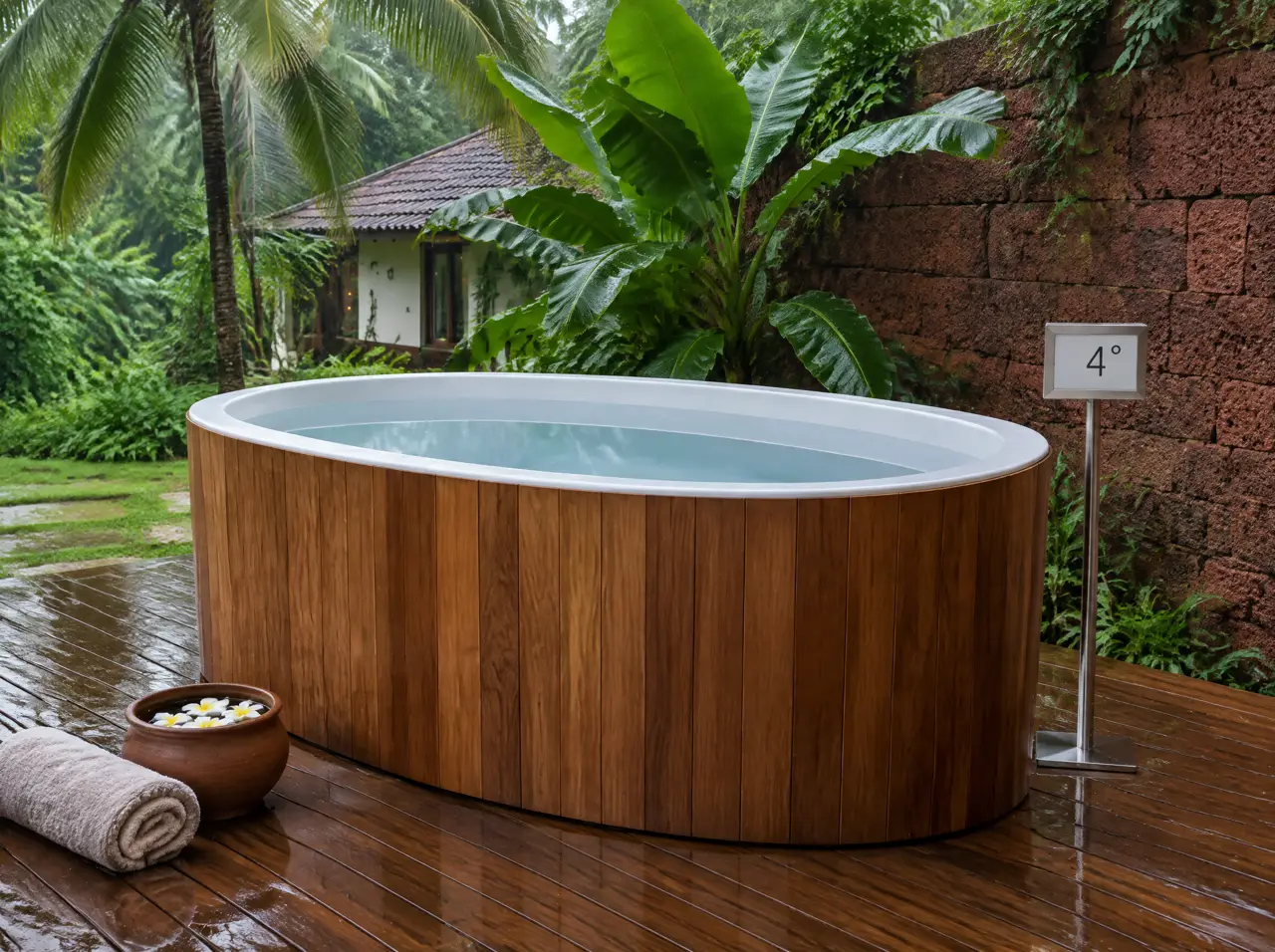
Wooden plunge tubs
Oiled timber staves, a smooth white liner, no metal hoops. For private homes, with a chiller sized by litres.
Open the page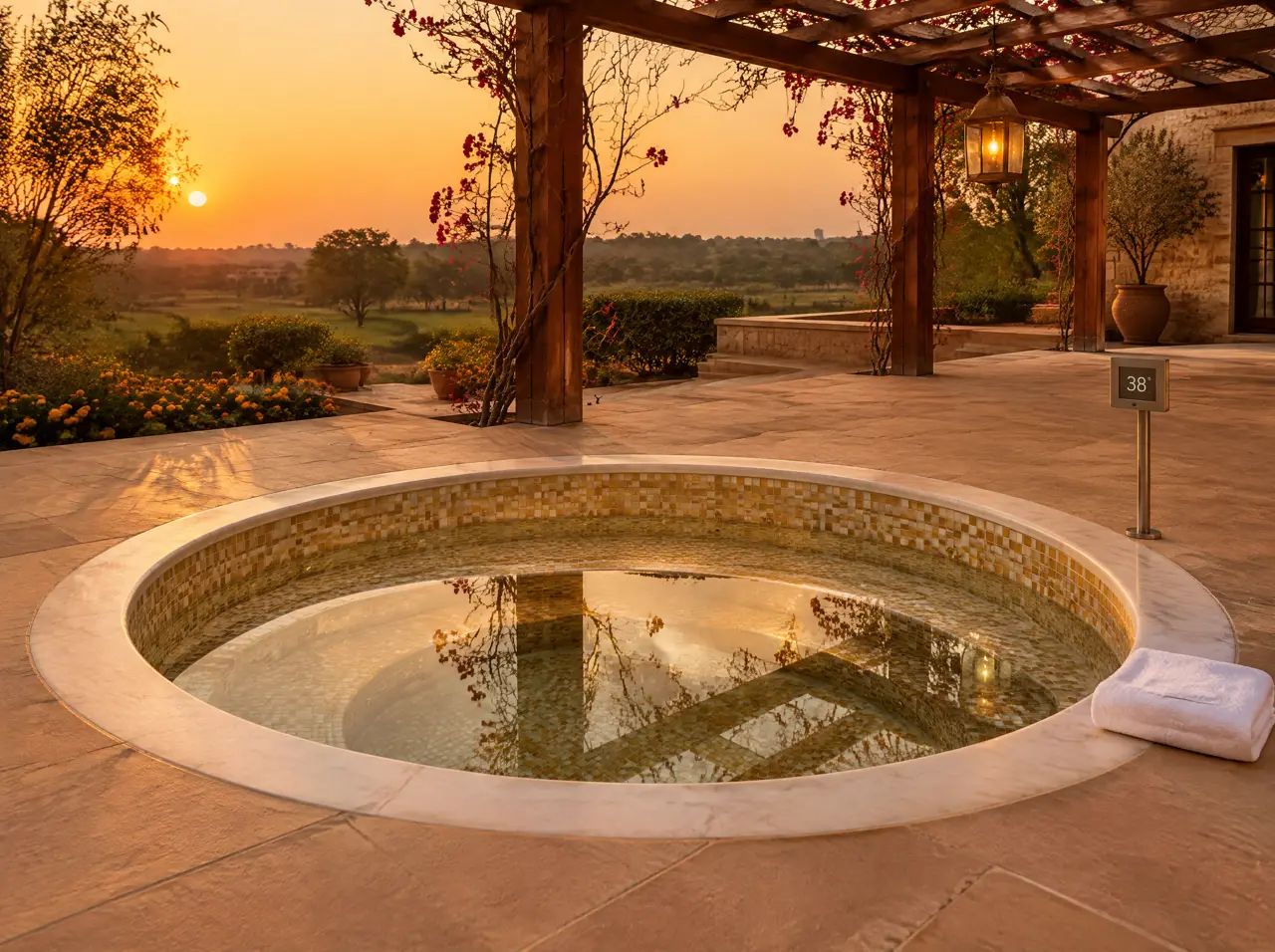
Jetted hot tubs, tiled or drop-in
Tiled built-in or acrylic drop-in, 2-6 seats at 36-38 °C, jets and heater in a plant room. Homes and hospitality.
Open the page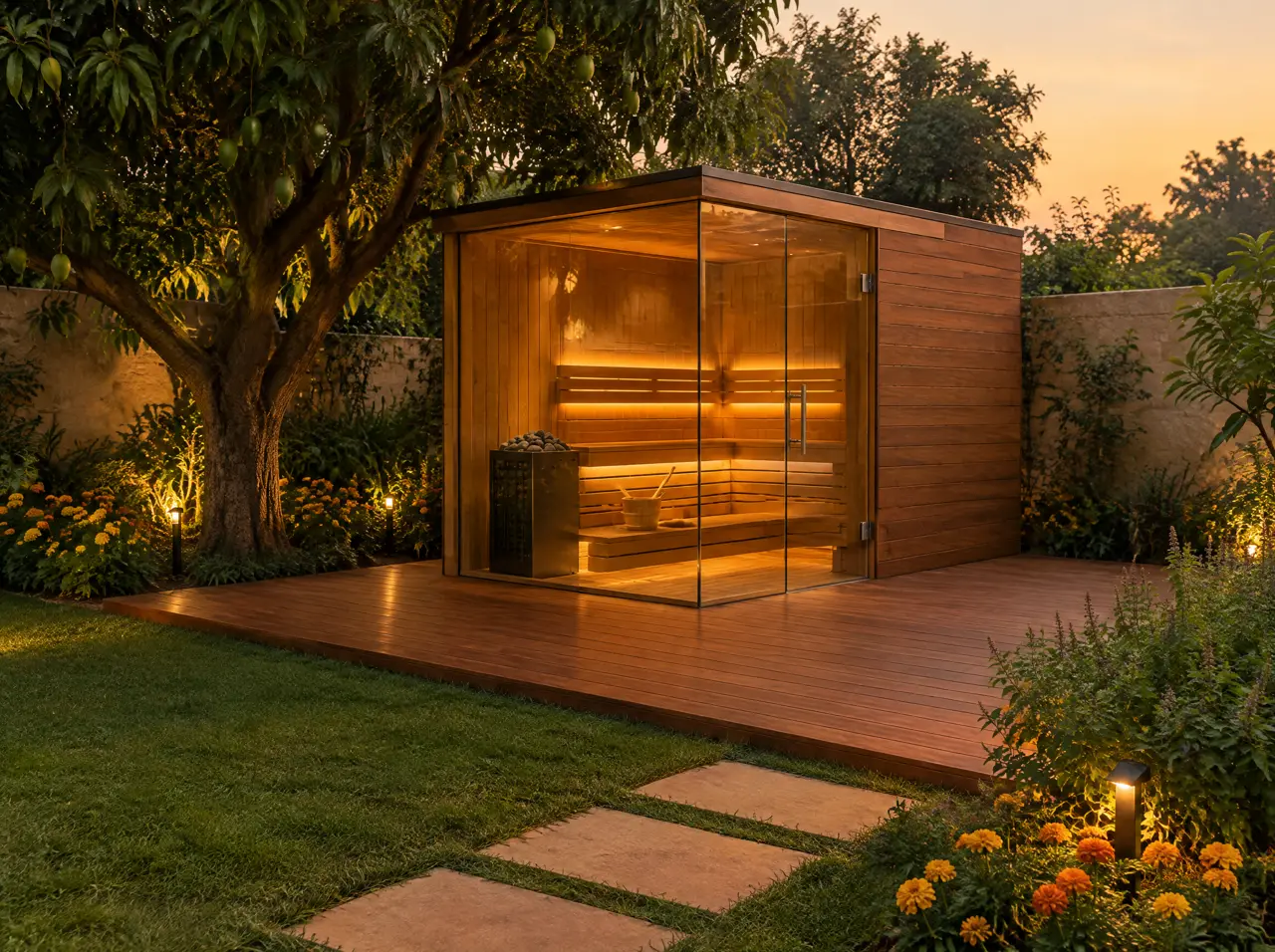
Farmhouse saunas
Free-standing cabins with glass on two sides, on a groomed deck, with a plinth built for monsoon and termites.
Open the pageSpecify this system
Send a photo of the deck or lawn; the tub, its heater and its cover come back drawn in
Send the plan; the layout comes back
A floor plan or three photographs, the location of the distribution board and what you intend to build. The reply is a 3D layout, an equipment schedule and a range in lakh.
Open WhatsApp with the briefSpecify the suite first